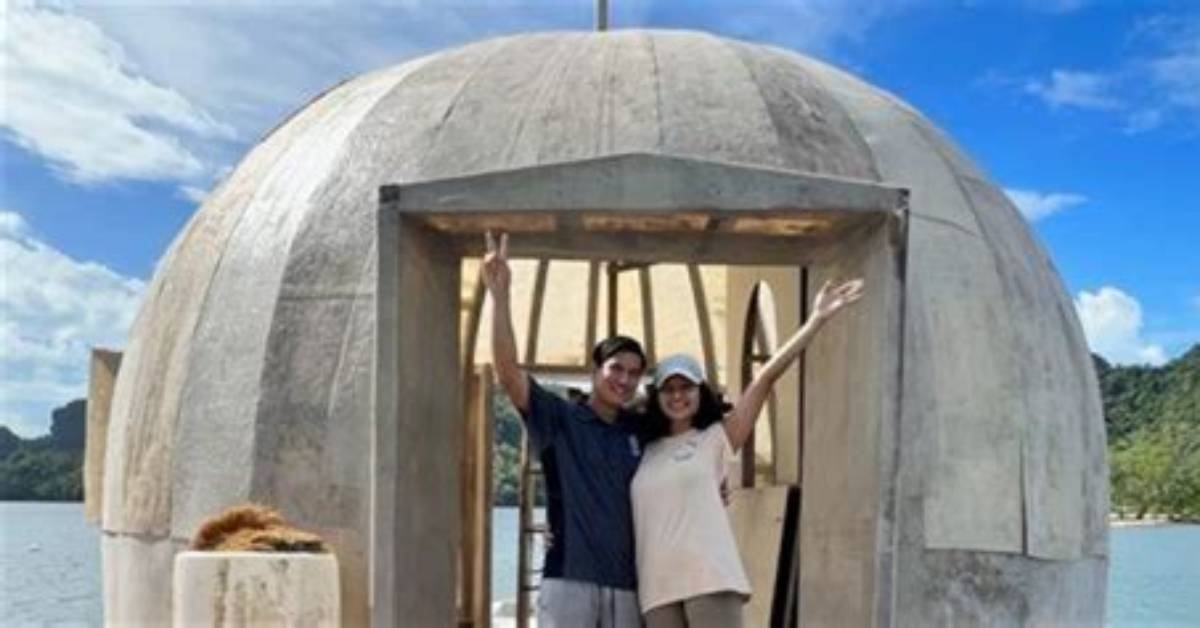
The brainchild of Hakim Azly, 34, and his wife Reena Sayra, 33, the inspiration behind the house is as literal as it gets.
"One day, we were walking down the beach when we saw a coconut floating on the water, and we thought to ourselves, 'How cool would it be to build something like that?'" Azly, an architect, told Business Insider.
The couple lives in Langkawi with their young child. Langkawi — a cluster of tropical islands in the Andaman Sea — is about a one-hour flight from Kuala Lumpur, the capital of Malaysia.
ADVERTISEMENT
The couple's floating coconut home is one of the 100 recipients of Airbnb's OMG Fund.
In 2022, Airbnb held a competition that would award 100 people $100,000 each to build quirky, short-term vacation rentals for the platform.
"Winning the competition accelerated our launch and construction timeline," Azly said. "But in reality, we wanted to build this no matter what. It was just going to take a longer time and be funded by ourselves."
According to the rules of the contest, winners have to use the prize money for the sole purpose of building or remodeling the space, which will be listed for rent on the Airbnb platform.
ADVERTISEMENT
Winners are also forbidden from listing the home on other short-term rental platforms for a year.
First things first, a fish farming license
As the couple found out, building a floating home isn't as straightforward as it seems.
"One of the things we learned is that there's not one building that we go to say, 'Hey, what do we need to make this work?'" Azly said. "We have to go to every government agency and ask them whether we need something from them or not."
ADVERTISEMENT
In Langkawi, the couple learned they needed a fish farming license to operate something floating on the water.
"As a result, we needed to take care of fish and make sure that we actually have a fish farm first," Azly said.
Only then were they allowed to build the floating home, which had to be attached to the farm, he said.
Weather-resistant building materials were a must
ADVERTISEMENT
The project's next step was to build the floating platform, followed by the main dome structure of the house and the deck.
After considering materials such as metal and bamboo, the couple eventually decided to build the dome out of fiberglass, Azly said
"We understood our site to be salt water, so metal was out of the box. We also wanted to make sure that the structure was secure and could last decades, but we were worried that bamboo would rot over time," Azly said.
He added that the fiberglass structure was then covered in thatch to mimic a coconut's outer husk.
ADVERTISEMENT
"We looked at using real leaves, but we were worried about flammability risks," Azly said.

