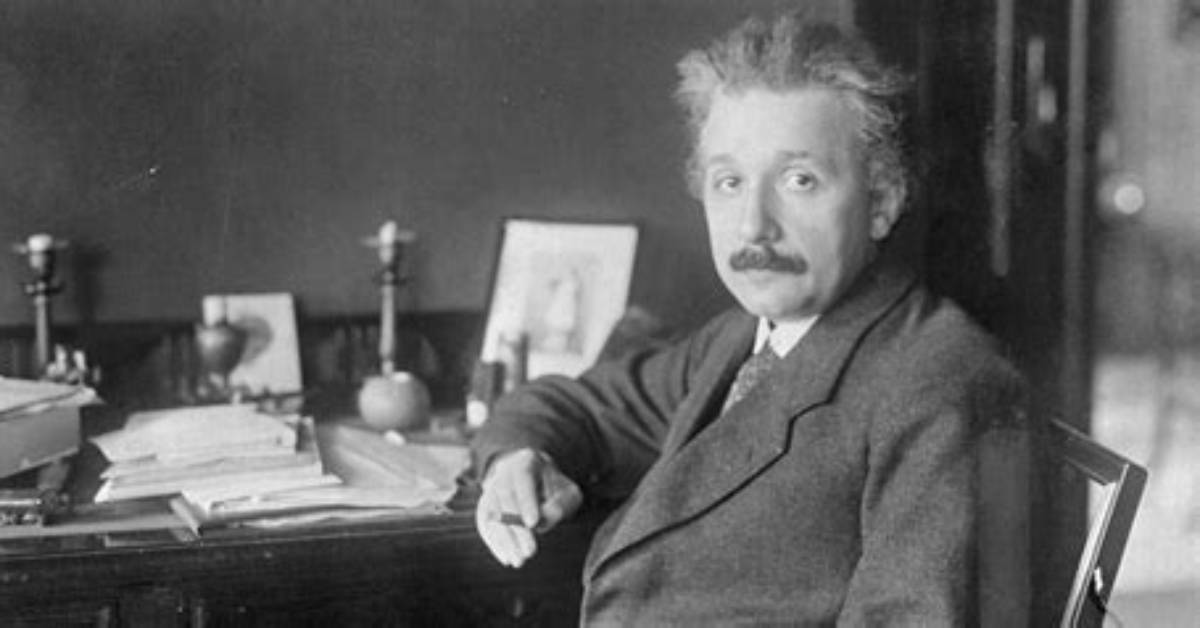
One of the most influential scientists of the 20th century, Albert Einstein is well-known for developing the theory of relativity, as well as his other important contributions to quantum mechanics and physics. But shortly before to his death in 1955, Einstein reflected on his life and identified his single greatest regret: his role in the development of the atomic bomb.
Although acquainted with physicist J. Robert Oppenheimer, Einstein never worked on the Manhattan Project that led to the development of nuclear weapons, nor was he aware of plans to drop the bombs at Hiroshima and Nagasaki. But Einstein and his colleague Leo Szilard played a crucial role in encouraging President Franklin D. Roosevelt to pursue the bomb in the first place.
A Startling Visit from a Friend
It all started with a visit by Szilard, a Hungarian-German physicist who previously studied with Einstein in the 1920s. Their research led to the creation of a refrigerator pump that required no moving parts, resulting in what is most commonly called the Einstein refrigerator, according to Genius in the Shadows, a Szilard biography by William Lanouette.
After their collaboration, Szilard conceived the idea of a nuclear “chain reaction” while working in London in 1933. The next year, he convinced the British government to make his chain reaction patent a military secret, according to Lanouette, successfully forestalling a nuclear arms race with Adolf Hitler, who by then was the Chancellor of Germany.
However, after scientists in Germany experimentally split the uranium atom in 1938, Szilard became deeply concerned about idea of Hitler obtaining an atomic bomb first and began raising alarm bells among his personal connections. In Lanouette’s words, he “worked frantically to start the very arms race he had feared.”
In 1939, Szilard visited his old friend Einstein, stunning the fellow physicist by describing the nuclear chain reaction concept. “I haven’t thought of that at all,” Einstein admitted, according to Lanouette. Einstein immediately agreed to warn his friends in the Belgian Royal Family that Nazi Germany might have eyes on the Belgian Congo, which contained the world’s largest uranium supply.
But after that initial meeting, Szilard became convinced that U.S. officials should be warned about Germany’s intentions as well. Szilard and Einstein met for a second time three weeks later, discussing how to get word to President Roosevelt and starting work on one of the most impactful and historic letters in the 20th century.
The Einstein-Szilard Letter
Through friends, Szilard met with Alexander Sachs, a Wall Street banker with access to the White House. Sachs said he had already spoken with Roosevelt about uranium but that the government decided not to pursue uranium research because Columbia University physicists had told them the prospects of an atomic bomb were minimal, according to The New World 1939/1946: A History of the United States Atomic Energy Commission.
Sachs felt Roosevelt might be persuaded by someone of Einstein’s reputation, according to the book. Einstein—who was also encouraged by Hungarian physicists, including refugees Eugene Wigner and Edward Teller—sent a letter dated August 2, 1939, urging Roosevelt about the possibility that Nazi Germany could develop an atomic bomb.
“In the course of the last four months it has been made probable… that it may become possible to set up a nuclear chain reaction in a large mass of uranium by which vast amounts of power and large quantities of new radium-like elements would be generated,” the letter read. “Now it appears almost certain that this could be achieved in the immediate future.”
Warning that this phenomenon could also lead to the construction of particularly devastating bombs, Einstein encouraged Roosevelt to consider a similar program in the United States and urged him to make contact with physicists working on chain reactions in the United States, according to the letter.
Preoccupied with events in Europe, Roosevelt didn’t respond for nearly two months, making the physicists fear he wasn’t taking the threat of nuclear warfare seriously, according to the U.S. Department of Energy. On the contrary, however, Roosevelt felt Hitler achieving unilateral possession of such powerful bombs would pose a grave risk to the nation.

