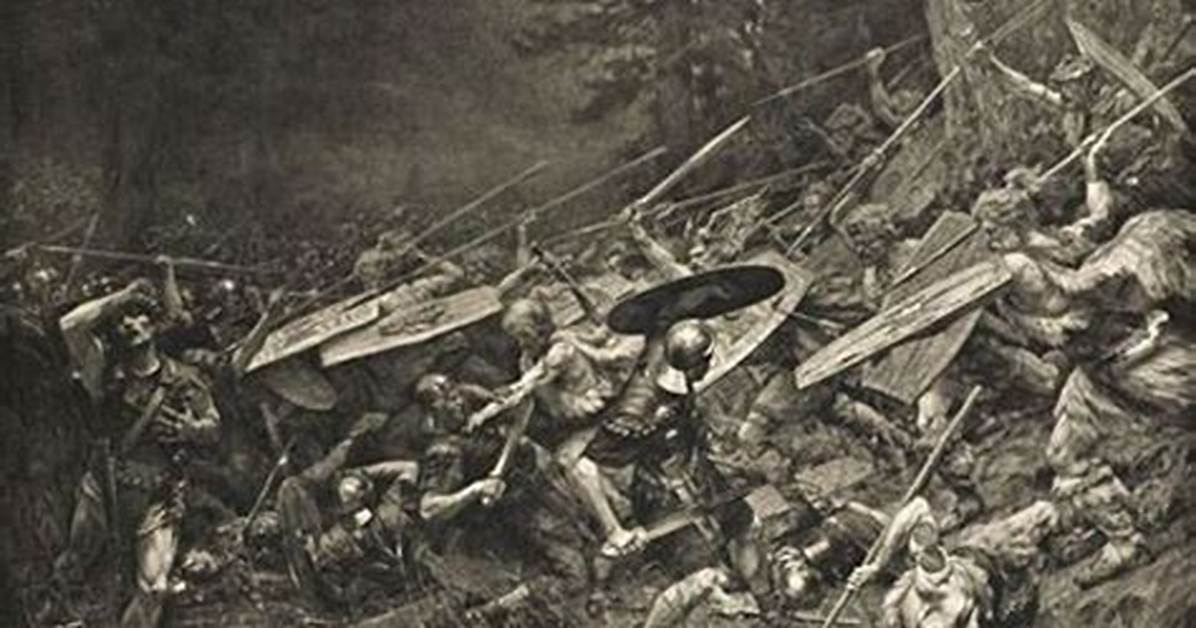
The Battle of Teutoburg Forest is perhaps one of the most consequential battles in the history of the Western world. Also known as the Varian Disaster, the battle saw Germanic tribesmen led by a Roman-trained general decimate three legions of Roman soldiers.
A group that the Romans deemed barbaric and uncivilized would use guerrilla warfare and insider information to defeat the most powerful military in the world. Their victory would halt Roman expansion and dictate the future of Europe. It would be immortalized in German myth for centuries.
An Expanding Empire
The Roman Empire was the most powerful force in the world by the 1st century BCE. It rapidly expanded and conquered neighboring regions.
The legions of Rome expanded across far-reaching swathes of land. They encompassed a wider variety of people. The ability to occupy the land and expand further required that non-Roman citizens be admitted into the military forces and trained.
Although non-Romans could not join the Roman legions, military forces called auxiliaries were formed so that the military could continue to grow. Roman military forces would provide training to these auxiliary forces. They would then march with the Roman legions or be dispatched to regions outside of their original homeland.
This had the dual benefit of assisting with the process of Romanization by letting other non-Romans help assimilate new people into the multi-ethnic empire.
Auxiliary Training
It is through this auxiliary program that Arminius of the Germanic Cherusci tribe first gained his military training.
Arminius was a Cherusci prince who grew up integrated into the Roman Empire, even gaining Roman citizenship. He received military training as an auxiliary and became intimately familiar with Roman tactics.
In 4 CE, he was given command of auxiliary forces. In 8 CE, he returned to Germania to serve under the regional governor Publius Quinctilius Varus.
Varus was a Roman politician and general who had previously ruled over a region of Africa. His strict rule over Roman-deemed heretics defined his political legacy. Emperor Augustus made him the governor of Germania in 7 CE.
The emperor encouraged Roman expansion in the region. Perhaps expecting a similar level of cunning and heavy-handedness that Varus had demonstrated in Africa.
By 8 CE, Arminius warned Varus of potential revolts from local Germanic tribes. He quickly began to prepare his legions in response.

