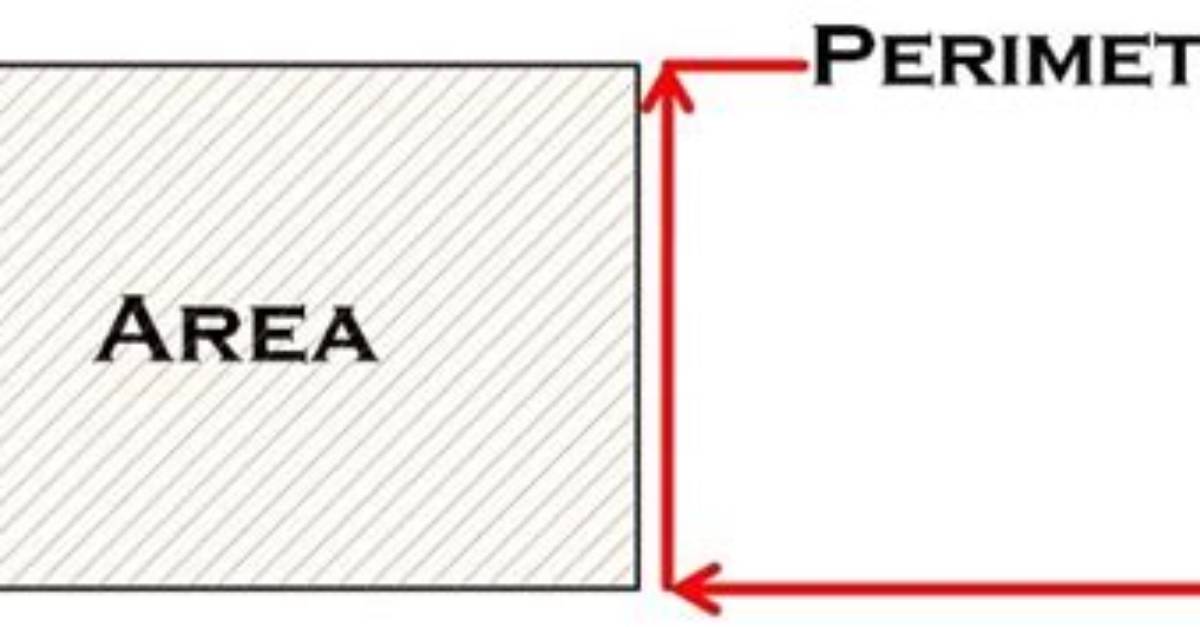
Area and perimeter are two fundamental concepts in geometry that describe different aspects of a shape or a region. Here's a breakdown of the key differences between them:
Definition:
Area: The area of a shape or region is the measure of the space enclosed by the boundary or the surface of that shape. It is usually expressed in square units (e.g., square meters, square feet) because it represents the amount of space that can be filled within the shape.
Perimeter: The perimeter of a shape or region is the total length of the boundary or the distance around the outer edge of the shape. It is expressed in linear units (e.g., meters, feet) because it represents the distance you would need to travel along the edge to go all the way around the shape.
Measurement:
Area is a two-dimensional measurement, as it involves the concept of space within a region.
Perimeter is a one-dimensional measurement, as it simply involves measuring the length around the boundary of a shape.
Units:
Area is measured in square units, such as square meters (m²) or square feet (ft²).
Perimeter is measured in linear units, such as meters (m) or feet (ft).
Calculation:
Area is calculated differently for different shapes. For common shapes like rectangles, triangles, and circles, there are specific formulas to calculate their areas.
Perimeter is calculated by adding up the lengths of all the sides or segments that make up the boundary of a shape.
Example:
For a rectangular garden with a length of 10 meters and a width of 5 meters:
The area would be 10 meters * 5 meters = 50 square meters.
The perimeter would be 2 * (10 meters + 5 meters) = 30 meters.
Use Cases:
Area is often used to determine quantities like the amount of paint needed to cover a wall, the area of a field, or the space enclosed by a fence.
Perimeter is used for calculating the length of materials required for fencing, the distance around a track, or the outline of a property.
In summary, area and perimeter are both important measurements in geometry, but they provide different information about shapes and regions. Area tells you how much space is enclosed within a shape, while perimeter tells you the total length of its boundary.
What is Area?
Area is a measure of the amount of space enclosed by a two-dimensional shape or surface. It quantifies the extent or size of a flat or planar region. In mathematics and geometry, area is typically expressed in square units, such as square meters (m²), square feet (ft²), square kilometers (km²), or square miles (mi²), depending on the context and the units of measurement used.
The formula for calculating the area of various geometric shapes is different. Here are some common formulas:
Rectangle: The area of a rectangle is given by multiplying its length (l) by its width (w), i.e., Area = l * w.
Square: Since all sides of a square are equal, you can calculate its area by squaring the length of one of its sides, i.e., Area = side².
Triangle: The area of a triangle can be calculated using the formula Area = (base * height) / 2, where the base is the length of the triangle's bottom side, and the height is the perpendicular distance from the base to the top vertex.
Circle: The area of a circle is calculated using the formula Area = π * r², where π (pi) is approximately 3.14159, and r is the radius of the circle.
Trapezoid: The area of a trapezoid is given by the formula Area = (1/2) * (sum of the lengths of the parallel sides) * height.
Parallelogram: The area of a parallelogram can be found by multiplying the length of one of its sides (base) by the perpendicular height to that base, i.e., Area = base * height.
These are just a few examples, and there are many other geometric shapes with their own specific formulas for calculating area. The concept of area is fundamental in mathematics and has applications in various fields, including geometry, physics, engineering, and geography, among others. It helps quantify the extent or size of objects or regions in the two-dimensional plane.
What is a Perimeter?
Perimeter refers to the distance around the outer boundary of a two-dimensional shape or object. It is the sum of all the sides or edges that enclose the shape. Perimeter is commonly used in geometry to measure the length of the boundary of various geometric figures, such as rectangles, squares, triangles, circles, and irregular shapes.
The formula to calculate the perimeter of different shapes varies depending on the shape:
Rectangle: Perimeter = 2 * (length + width)
Square: Perimeter = 4 * side length
Triangle: Perimeter = sum of the lengths of all three sides
Circle: Perimeter is more commonly referred to as the circumference, and it is calculated as C = 2πr, where "r" is the radius of the circle, and π (pi) is a mathematical constant approximately equal to 3.14159.
In the context of real-world applications, knowing the perimeter of objects can be useful in a variety of situations, such as determining how much fencing is needed to enclose a garden, finding the distance around a running track, or calculating the amount of material needed to frame a picture.
Understanding perimeter is fundamental in geometry and helps describe the "outer boundary" of shapes, which is essential in various mathematical and practical contexts.

