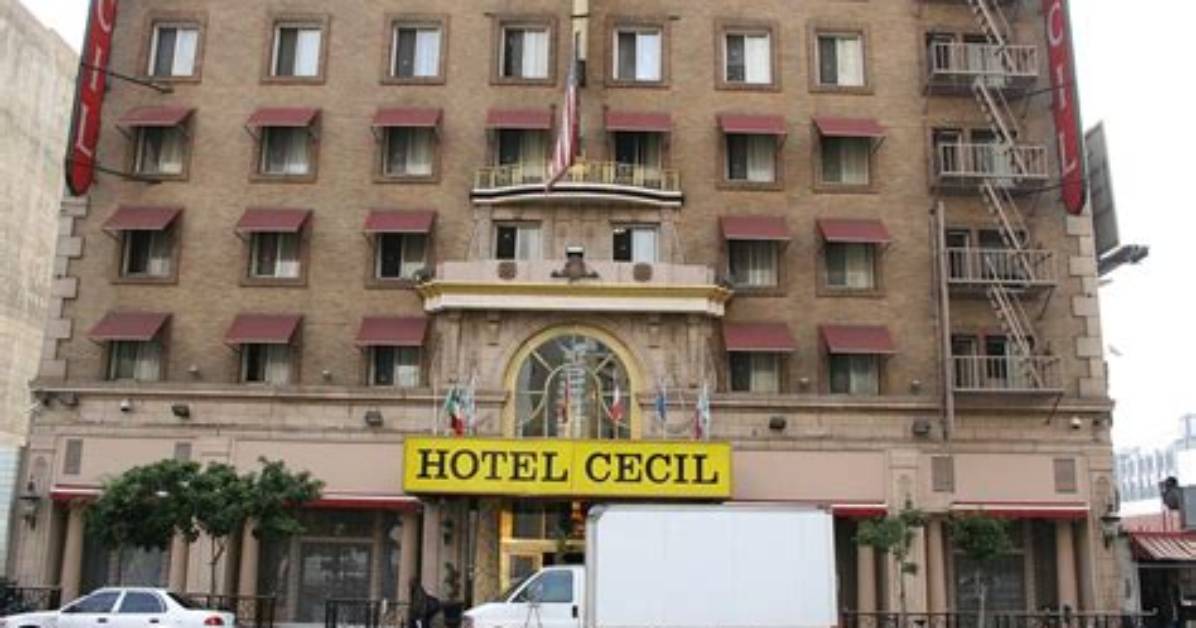
Hidden in the heart of downtown Los Angeles, there is a building that has witnessed a century’s worth of secrets, mysteries, and darkness – the Cecil Hotel.
It’s an iconic building shrouded in a haunting aura. The infamous hotel has become a place of near-supernatural fame. Echoes of names from years past, like the “Night Stalker” or the Black Dahlia, still reverberate through the halls.
It has grand facades and once-luxurious interiors. For decades it beckoned travelers to experience a world of elegance and sophistication. Yet behind the glamor and opulence, this intriguing establishment holds a troubled past that continues to haunt its many rooms.
What gives rise to its sinister reputation? What draws us to its tales of dark events and unsolved mysteries? Ultimately, the truth lies in answering the question: what happened in the Cecil Hotel?
Early Years, Grandeur, and Popularity
In 1924, amidst the vibrant energy of the booming city of Los Angeles, three hoteliers – William Banks Hanner, Charles L. Dix, and Robert H. Schops – had a vision. Together, they joined forces to create the Cecil Hotel.
Their goal was to create a luxurious haven for business travelers and tourists seeking respite in the heart of the city. The hotel was designed by the talented architect Loy Lester Smith in a Beaux-Arts style. And it was constructed under the watchful eye of W. W. Paden.
From the beginning, the Cecil Hotel embodied wealth and opulence. With a price tag of $1.5 million, the Cecil boasted a grand marble lobby. It was adorned with exquisite stained-glass windows and other expensive decor.
In the end, the enterprise would cost about $2.5 million for the hoteliers.
The Cecil Hotel was a sanctuary that welcomed the highest of society. It promised an indulgent and unforgettable experience. When it finally opened its doors a few years later in 1927, it immediately became a destination of choice for many travelers to the city.
The lavish interiors were adorned with gleaming marble. It exuded an air of sophistication and prestige that was tailored for luxury-seeking tourists and business people. In truth, the Cecil catered to an interesting mix of clientele.
However, the hotel’s fortunes began to take a dramatic turn just two years later. It began with the devastating Wall Street Crash of 1929, which plunged the United States into the depths of the Great Depression.
As the economy crumbled, so did the surrounding neighborhood, including the infamous Skid Row. The once-thriving area became synonymous with violence and crime. This cast a shadow over the Cecil and signaled the beginning of a tumultuous journey ahead.
The Cecil’s Decline and Notoriety
As the 1940s unfolded, the Cecil Hotel’s once-glamorous façade began to fade. The tides of change swept through the neighboring area known as Skid Row.
This once-thriving district became an enclave for transients. There was an estimated population of up to 10,000 homeless individuals within a mere four-mile radius.
The hotel’s decline also paralleled the deteriorating conditions of its surroundings. This set the stage for a series of unfortunate events that would forever give its name worldwide notoriety.
You see, through the years, the Cecil Hotel also became a hub for activities society often preferred to keep hidden.
It attracted sex workers seeking clients. It provided a clandestine backdrop for illicit encounters. Adulterous affairs found their meeting place within its walls. This added an extra layer of intrigue to the hotel’s reputation.
The dark underbelly of society seemed to find solace in the Cecil. And the situation would only grow darker and more disturbing. Over time, the Cecil Hotel acquired a haunting notoriety for its association with death and suicide.

