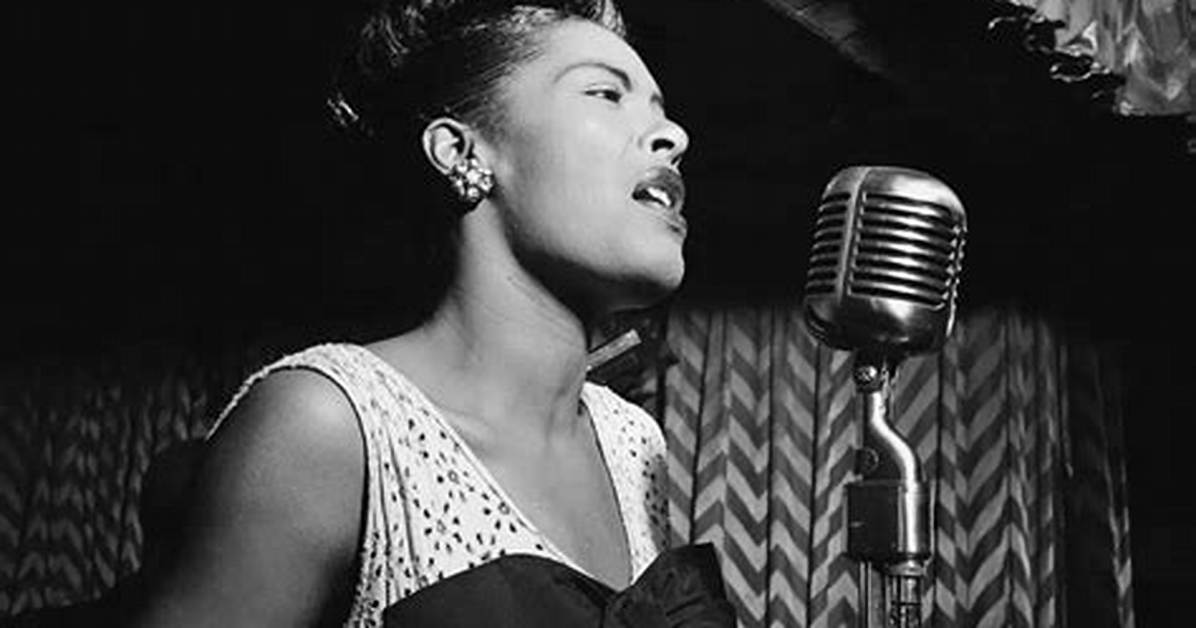
Billie Holiday was gifted with one of the most identifiable voices in the history of recorded music. It was a voice that throughout her 26-year career (and since her untimely death in 1959) has indisputably placed her among the all-time “greats.”
Songs like, “Them There Eyes” (1939), “Loverboy” (1941), “Good Morning, Heartache” (1946), and “T’ain’t Nobody’s Business If I do” (1949), represent an era when Jazz dominated the music scene. And no one represented it better than Billie Holiday.
From 1939 to her death in 1959, the US government pursued Holiday because she was black and wealthy. It started because she dared to sing a song called “Strange Fruit.”
It was a song whose imagery serves as a metaphor for dead bodies hanging from trees (like fruit). It sang of the victims of racist lynching in 20th-Century America.
In May of 1947, Holiday was ordered by FBI agents not to sing that particular song at a concert in Philadelphia. She ignored this warning.
That night, narcotic agents raided her hotel room. They then shot at her car as she was returning from the performance. She was later arrested on narcotics charges and sentenced to a year in prison.
FBI files from 1949 state that Holiday has been intentionally discredited to set an example to other “uppity” Blacks. One of the agents involved, Colonel George White, told a reporter that Holiday’s “fancy coats and fancy automobiles and her jewelry and her diamonds” generated much resentment among both Whites and Blacks.
White took it as his personal mission to put a stop to it.
Dire Beginnings
“Billie Holiday” was born Eleanora Fagan on April 7, 1915, in Philadelphia, Pennsylvania, to Clarence Halliday (a Jazz guitarist and banjo player) and 13-year-old Sarah Julia “Sadie” Fagan. Sarah had moved to Philadelphia after being forced to leave her parents’ home in Baltimore, Maryland, for getting pregnant.
Disowned by her parents, Sarah arranged for Eleanora to live with her older, married half-sister, Eva Miller, in Baltimore. Not long after Eleanora was born, Halliday abandoned his family to pursue a career as a musician. Eleanora began life in extreme poverty.
Sarah often took what were then called “transportation jobs.” These were serving jobs on trains available to both female and male Blacks. Ultimately raised by Eva Miller’s mother-in-law, Martha Miller, Eleanora grew up barely knowing her mother. She had to rely on virtual strangers for the first decade of her life.
Education and Employment
Eleanora attended kindergarten at St. Frances Academy (an independent Catholic school with ties to the Black and Hispanic communities). However, she frequently skipped school.
Her truancy resulted in spending nine months in the House of the Good Shepherd. This was a Catholic reform school for errant African-American girls.
At this point, Sarah (who now called herself “Sadie”) had opened a restaurant called the East Side Grill. Compelled to work long hours helping her mother at the restaurant, Eleanora formally dropped out of school at age 11.
On Christmas Eve, 1926, “Sadie” returned to discover a neighbor, trumpet player Wilbur Rich, in her home. He was attempting to rape Eleanora. This confrontation resulted in Rich’s arrest.
As a state witness in a rape case, Eleanora was returned to the House of the Good Shepherd. However, this time she was under protective custody.
Eleanora was released the following February. She found a job running errands and scrubbing the marble steps of a local brothel. She also washed floors for neighboring families.
It was while working at the brothel that Eleanora first heard the records of Jazz greats Louis Armstrong and Bessie Smith. In her autobiography, Lady Sings the Blues, she cites the song “West End Blues” (written by Joe “King” Oliver) as one of her first musical inspirations.

