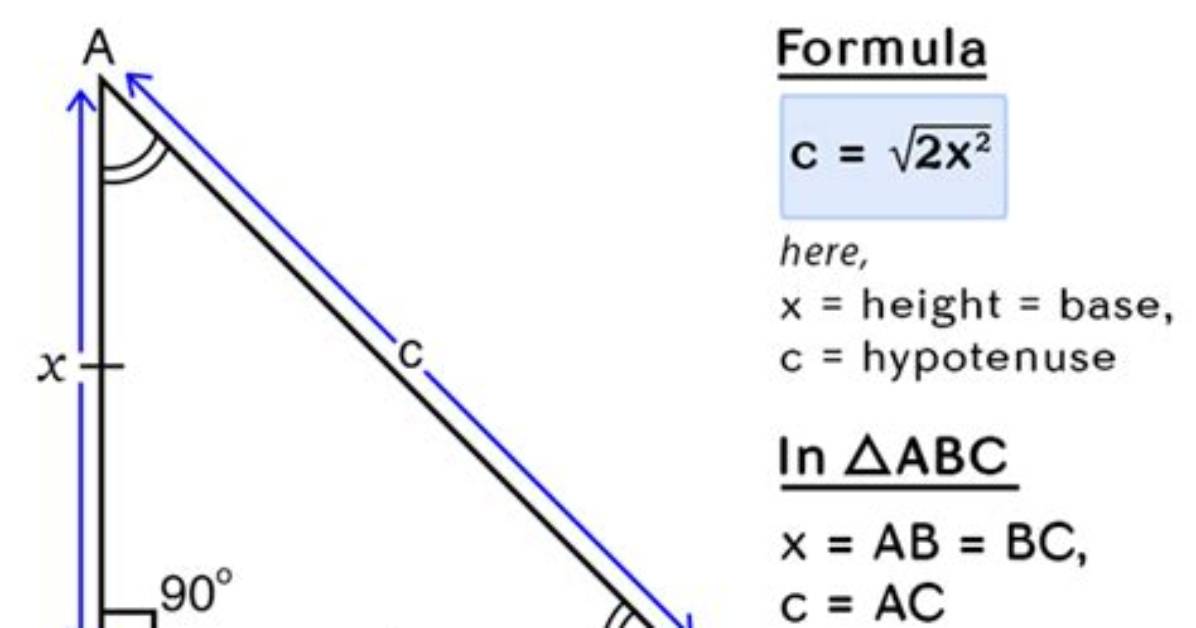
The Correct answer is 6√2 inches
Explanation
1. Formula:
c^2 = a^2 + b^2
where:
c is the hypotenuse (12 inches in this case)
a and b are the lengths of the legs (which are equal in an isosceles triangle)
2. Substituting known values:
We know c = 12 and we want to find a (which is equal to b). So, the equation becomes:
12^2 = a^2 + a^2
3. Combining like terms:
12^2 = 2a^2
4. Isolating a:
To solve for a, we need to get it by itself. Divide both sides by 2:
12^2 / 2 = a^2
5. Taking the square root:
Since we're dealing with squared values, we need to take the square root of both sides to find the actual length of a:
sqrt(12^2 / 2) = sqrt(a^2)
6. Simplifying:
6√2 = a
Therefore, the length of each leg in the isosceles right triangle is 6√2 inches.
What is the Pythagorean theorem?
In a right triangle, the square of the hypotenuse (the side opposite the right angle) is equal to the sum of the squares of the other two sides (called legs).
Formula:
The relationship between the sides of a right triangle can be expressed mathematically using the following formula:
c^2 = a^2 + b^2
where:
crepresents the length of the hypotenuse (longest side)aandbrepresent the lengths of the other two sides (legs)

