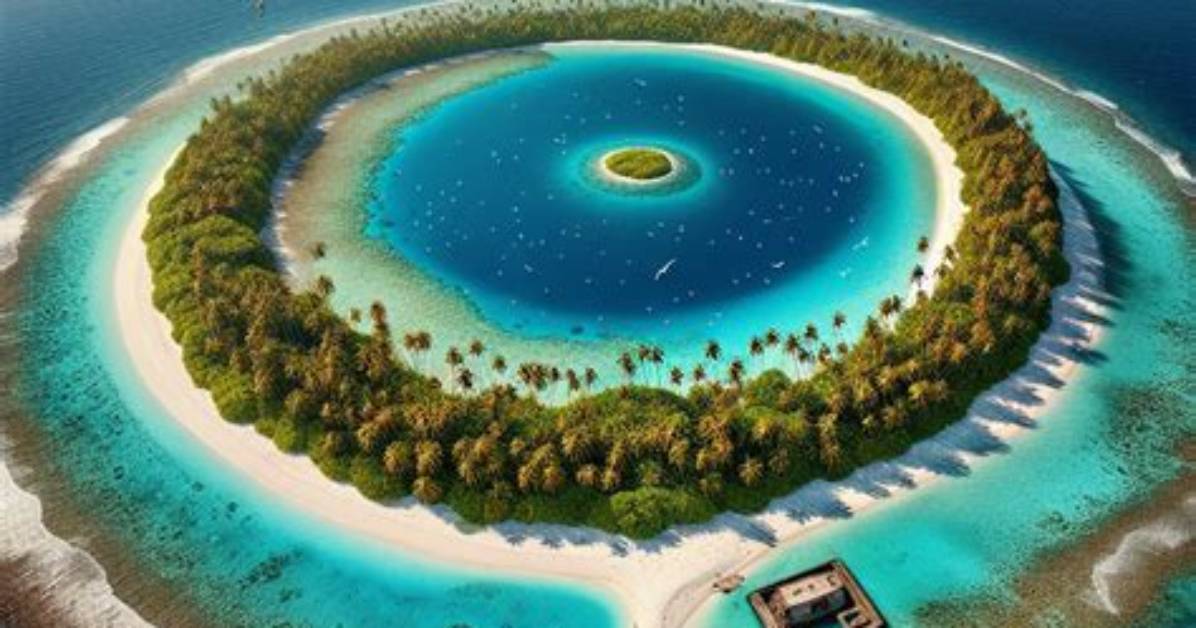
Clipperton island’s place in history is bizarre. Located 670 miles southwest off the coast of Mexico in the eastern Pacific and covering only a mere 6 square kilometers of land, Clipperton isn’t exactly a fantasy tropical island.
This remote and barren island is filled with poisonous crabs, relentlessly battered by rains and storms from May to October, and reeks of ammonia for the rest of the year. Yet, despite these inhospitable factors, Clipperton was a diplomatic headache for much of history and was home to a much more bizarre incident of cruelty and murder a little over a century ago.
The record of the first person to discover Clipperton island is disputed. Some sources claim that this remote island was first discovered in 1521 by Ferdinand Magellan. Other sources argue that a Spanish sea captain named Alvaro de Saavedra Cerón was the first to discover the island in 1526. He named it La Isla de Médanos.
Clipperton island gets its current name from John Clipperton, an early 18th-century English privateer – or pirate for hire – who served the British crown and operated along Central America’s west coast.
John Clipperton was trying to stop Spanish expansion into Central America and Mexico. Due to the island’s location to the west of the coast of Guatemala and Mexico, He was said to have used the island as a base for his raids around 1705.
In 1711 it was rediscovered by the French explorers Martin de Chassiron and Michel Du Bocage, who drew up the first map and claimed it for France; they renamed the island Île de la Passion, a name that clearly, did not stick.
The Battle for Guano
In 1804, a German geographer named Alexander von Humboldt was in Peru, and he noticed the natives using a particular substance called guano as fertilizer. So he took a sample of it back to Europe to have it analyzed. Back in Europe, the crop yields made using guano as fertilizer were astonishing.
Consequently, due to its large guano deposits, Clipperton island became subject to claims from France, the United States, and Mexico.
Guano is the accumulated excrement of seabirds and bats and is effective because it contains high content of nitrogen phosphate and potassium, essential for plant growth.
More interestingly, guano could also be used to create Gunpowder, which was a crucial reason why these three nations were fighting over ownership of the island.
In 1856, the United States passed the Guano Islands act, which made it legal for American explorers and companies to find guano-rich islands located around the Pacific and claim them for the United States, so long as they were uninhabited and unclaimed by another country.
In 1858, French Emperor, Napoleon III, responded by sending navy troops to annex the island as part of the French colony of Tahiti. But this didn’t settle the ownership question. A crew of Americans arrived at Clipperton island in 1892 with the plan of mining the extremely valuable guano deposits and spent the next few years making a profitable business out of it.
Mexican Ownership of Clipperton Island
With guano suddenly becoming big business, Mexico also became very keen on laying claim to nearby islands with deposits of guano and made the US aware that they considered Clipperton a part of the Mexican territory.
In 1897 Mexico reasserted its claim on the island again, and the President of Mexico, Porfirio Diaz, sent a gunboat to occupy and annex the island.
The Mexican troops sent by Diaz forcefully removed the small crew of Americans mining the guano deposits on the island and installed a Mexican flag to signal Mexican ownership.
While these three nations were already engaged in a diplomatic war to possess Clipperton island, a fourth nation came into the picture. In 1899 the British navy went to Annex Clipperton island.
America and France were not exactly pleased, to say the least, about this decision by the British, but Britain was the world’s naval superpower at the time, so there wasn’t much they could do about it.
President Porfirio Diaz, still interested in the island but knowing that he did not possess the military or naval might to repossess the island back from Britain, decided to make a deal with them.
The Brits could use Clipperton as they saw fit and reap the economic benefits. All they had to do was recognize Mexican sovereignty over the land, with the Brits agreeing to this proposition.
The British Pacific Island company won the rights to exploit the guano deposits in Clipperton island in 1906. They quickly built settlements on the island, planted more palm trees, and began growing vegetables in rock gardens.
But as the years rolled by, the British company was thwarted by expensive shipping costs and poor market conditions. Finally, it became clear that it wasn’t worth the effort because of the falling price of guano and expensive shipping costs. They eventually got frustrated and left the island in 1909, leaving behind a solitary caretaker.
With the British gone and inadvertently foregoing their claim to the island, France and Mexico signed an arbitration treaty, leaving King Victor Emmanuel III of Italy to decide who would become the rightful owner of the island. While he deliberated, the Mexican government sent men to guard the island.

