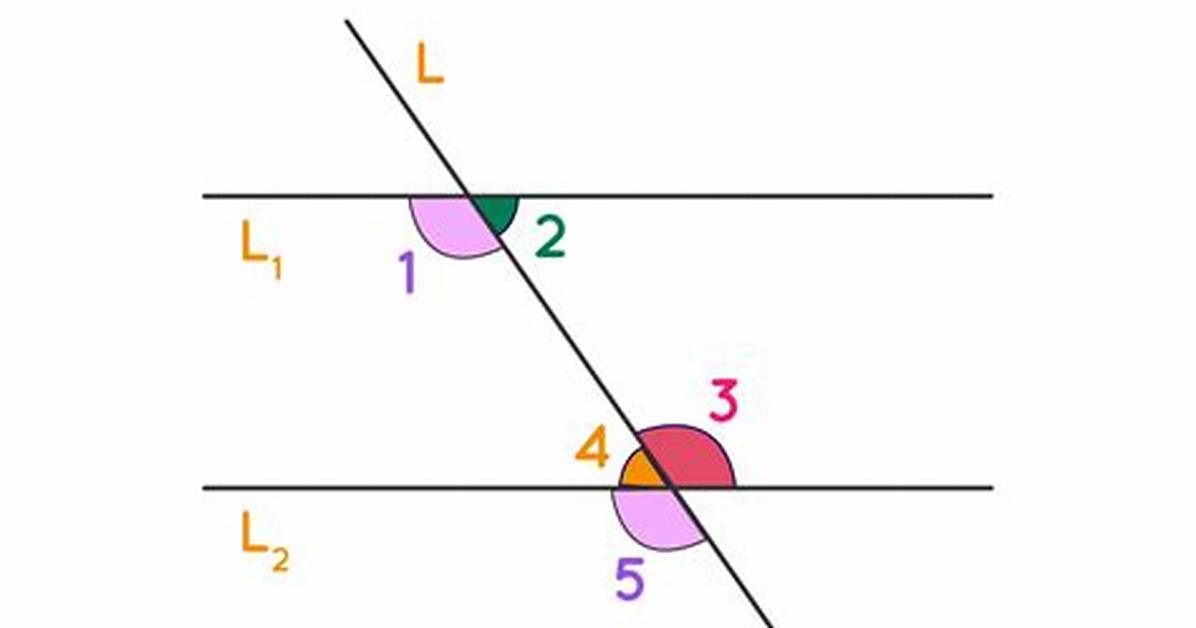
What Are Alternate Interior Angles In geometry to describe a specific type of angle relationship between two lines intersected by a transversal is termed as Alternate Interior Angles. The concept of alternate interior angles is important in geometry as it is often used to determine the parallelism of lines. But many are not aware of What Are Alternate Interior Angles. If you are searching for What Are Alternate Interior Angles, Read the content below.
What Are Alternate Interior Angles?
Alternate interior angles are a pair of angles that are located on opposite sides of a transversal line and are between two lines. They are interior angles, meaning they are located inside the two lines, and they are alternating, meaning they are not adjacent to each other. Alternate interior angles are congruent, meaning they have the same measure, if and only if the two lines being intersected by the transversal are parallel. In other words, if the lines are parallel, alternate interior angles are equal in measure. This relationship can be useful in solving geometric problems and proving the parallelism of lines.
To add more context, imagine two lines, line A and line B, that are intersected by a transversal line. On one side of the transversal, there will be a pair of alternate interior angles, one angle formed between line A and the transversal, and the other angle formed between line B and the transversal. On the other side of the transversal, there will be another pair of alternate interior angles, again one angle formed between line A and the transversal, and the other angle formed between line B and the transversal.
These alternate interior angles can be used in proofs and problem-solving in geometry and spatial reasoning. For example, they can be used to prove the parallelism of lines or to find the unknown measure of an angle in a triangle or polygon. In addition, alternate interior angles can also be used to find missing angles in a diagram by using the property that they are congruent if and only if the lines are parallel.
Alternate Interior Angles Theorem
The Alternate Interior Angles Theorem states that if two lines are cut by a transversal and the alternate interior angles are congruent, then the two lines are parallel. This theorem can be written as follows:
"If two parallel lines are cut by a transversal, then the pairs of alternate interior angles are congruent."
In other words, the theorem states that if the alternate interior angles are equal in measure, then the lines being intersected by the transversal are parallel. This theorem is often used in proofs and problem-solving in geometry to determine the parallelism of lines or to find unknown angle measures.
It is important to note that the converse of the Alternate Interior Angles Theorem is also true, which states that if the alternate interior angles are congruent, then the two lines are parallel. So, if you know that the alternate interior angles are equal in measure, you can conclude that the lines are parallel, and if you know that the lines are parallel, you can conclude that the alternate interior angles are congruent.
Example of Alternate Interior Angles Theorem
Here's an example to help illustrate the Alternate Interior Angles Theorem:
Consider two lines, line A and line B, that are intersected by a transversal line. On one side of the transversal, we have angle 1 formed between line A and the transversal, and angle 2 formed between line B and the transversal. On the other side of the transversal, we have angle 3 formed between line A and the transversal, and angle 4 formed between line B and the transversal.
Suppose that angle 1 and angle 3 have the same measure. According to the Alternate Interior Angles Theorem, this means that line A and line B are parallel. So, we can conclude that angle 2 and angle 4 also have the same measure.
In other words, if two parallel lines are cut by a transversal, then the pairs of alternate interior angles are congruent. In this case, the congruent angles are angle 1 and angle 3.
This theorem can be used in many geometric proofs and problem-solving situations to determine the parallelism of lines, find missing angle measures, or determine other relationships between lines and angles in a diagram.

