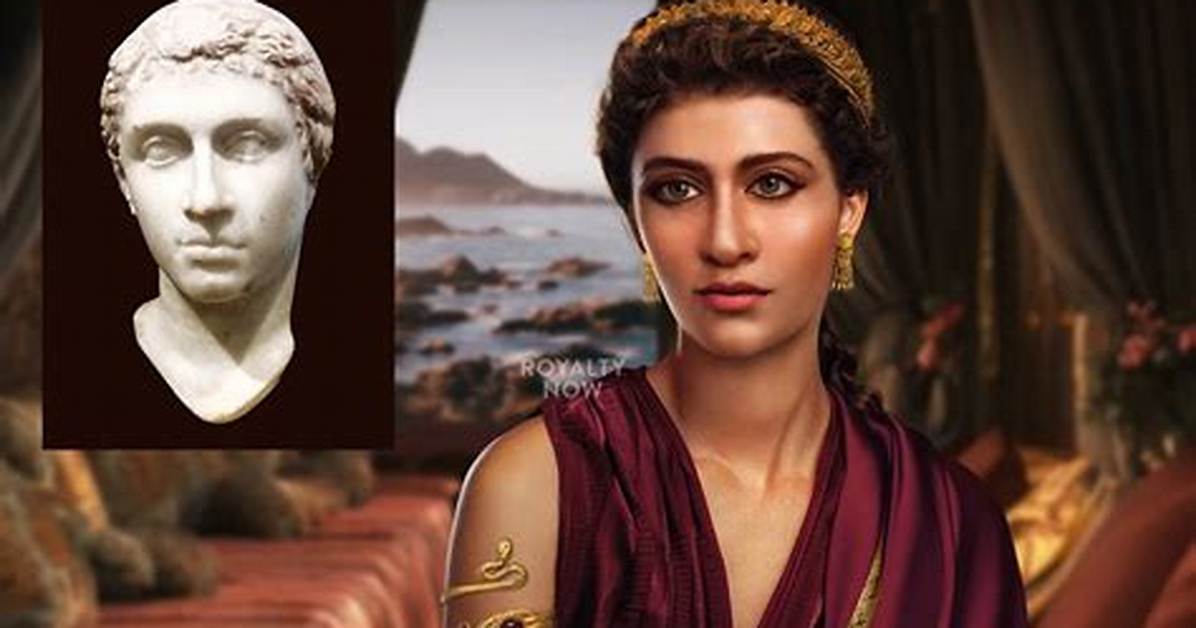
by The Archaeologist Editor Group
The Enigma of Cleopatra: Modern Reconstructions and the Quest for Her True Appearance
If one thing is clear from the various accounts and reconstructions of Cleopatra, it's that her allure went far beyond her physical appearance. Cleopatra VII, the last queen of Egypt, has been a character of fascination and intrigue for centuries. Known for her intelligence, charm, and political acumen, she was a woman who made a significant mark in a world dominated by men. She was fluent in multiple languages, well-versed in politics, and an astute diplomat—traits that made her a formidable leader.
However, the question of her physical appearance, specifically her beauty, has always been a topic of debate. Her true power lay in her intellect, her charm, and her political acumen. Cleopatra’s ability to captivate and influence others was central to her rule. She managed to form alliances with two of the most powerful Romans of the time—first Julius Caesar and later Mark Antony—which were crucial for the maintenance of her power in Egypt. These alliances and the relationships she forged speak volumes about her charisma and ability to persuade.
Documentation in the literature
One of the most enduring portrayals of Cleopatra is that of a woman of unparalleled beauty. This is a narrative that has been perpetuated by countless plays, movies, and novels, most notably William Shakespeare's Antony and Cleopatra. However, the historical texts present a somewhat different picture.
Plutarch, a Greek biographer and essayist, made the earliest surviving description of Cleopatra in his work "Parallel Lives". Interestingly, he doesn't dwell on her physical appearance but emphasizes her charismatic persona and intellectual prowess. He notes that "her actual beauty, it is said, was not in itself so remarkable, but the attraction of her person and the character that attended all she said or did were something bewitching."
Cassius Dio, another Roman historian, also focused more on Cleopatra's persuasive abilities and personal charm than her physical attractiveness. These descriptions suggest that Cleopatra’s allure was not based solely, or even primarily, on her looks.
Artistic Depictions and Coinage
In contrast to the romanticized portrayals of Cleopatra, the extant artistic depictions and coinage of her profile provide a more realistic, albeit stylized, representation of her appearance.
Coins minted during Cleopatra's reign depict her with a prominent nose, a strong chin, and deep-set eyes. Some historians believe that these coins were a deliberate political statement, indicating Cleopatra's desire to be seen as equal to her male counterparts.
Similarly, the few surviving statues and carvings of Cleopatra from the ancient world do not present an image of classical beauty. The Berlin Cleopatra, a painted limestone statue from the 1st century BC, shows her with a hooked nose and a stern expression.

